

What a $40 Trillion Debt Could Mean for Your Retirement
The national debt crossed $40 trillion this August, and if you are a few years from retirement it probably feels like someone else's problem, a number politicians argue about on television. I want to make the case that it is quietly becoming your problem, and that it is manageable as long as you see it coming. What matters is not the number itself but what it does to the things you can feel: interest rates, inflation, and the taxes and benefits you will live with for the next thirty years. So let me walk you through it in plain terms: how we got here, why the bill is finally coming due, and what it could mean for the three questions I hear most from people near retirement: taxes, Social Security, and the cost of living.
How we got here
It is easy to forget that we started this century in good shape. In 2000 the federal government ran a surplus, meaning it took in more than it spent, and the debt was a fraction of what it is now. The worry back then was that we might pay it off too fast.
What changed was not fraud or waste. It was a run of big things we chose not to pay for. Three wars, the latest this year in Iran. The 2008 financial crisis. A pandemic that pushed trillions out the door in a matter of months. And underneath all of it, the steady rise of Social Security and Medicare as the country grows older. David Kelly at J.P. Morgan puts the conclusion plainly: anyone serious about the debt has to be willing to raise taxes or cut spending on defense and the big retirement programs. There is no fourth option hiding in the budget.
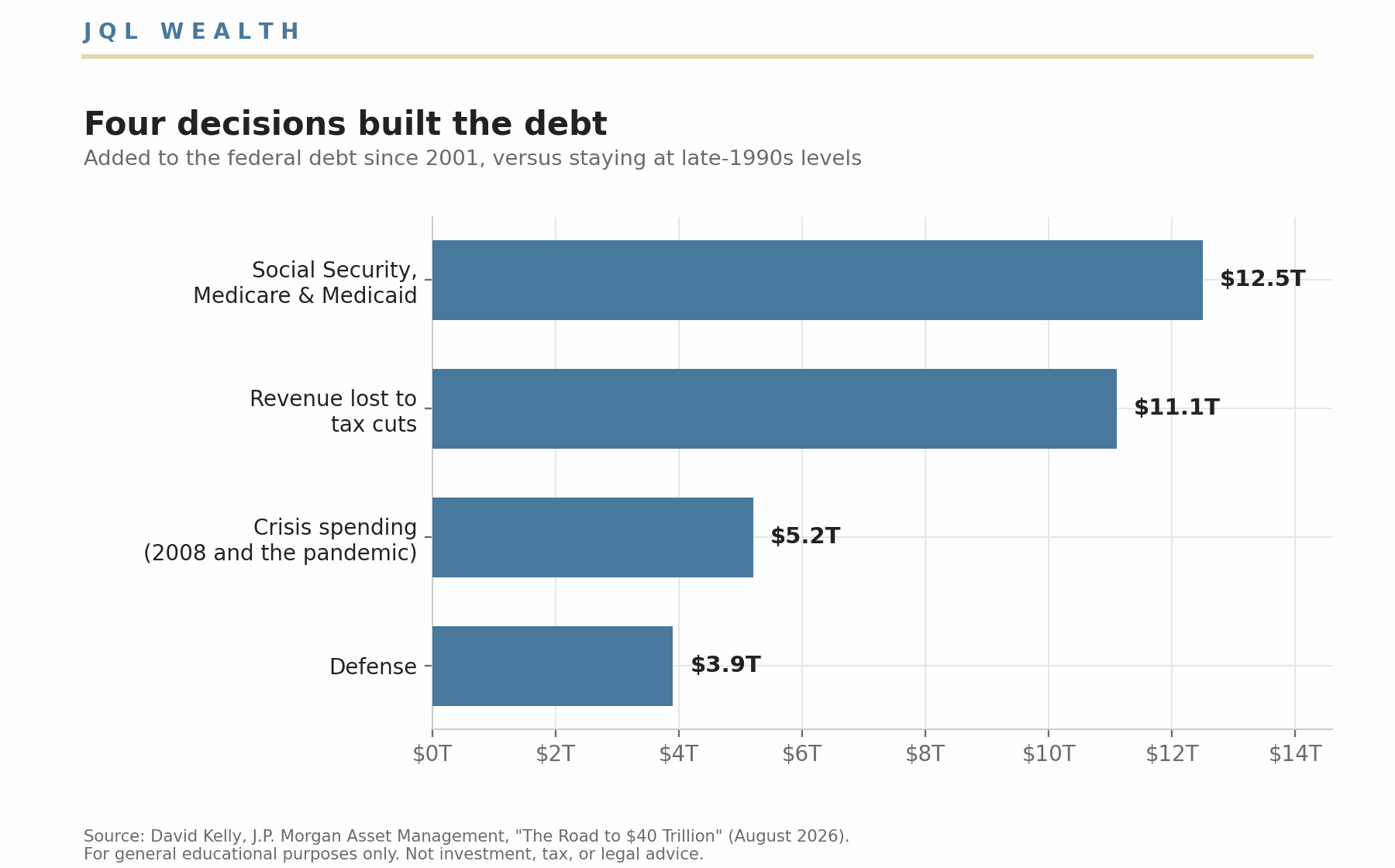
The uncomfortable part is that the pressure runs one way. An aging population means Social Security and Medicare keep climbing, not falling. Defense commitments are not shrinking. And the interest on the debt is now a line item of its own, over a trillion dollars a year, more than we spend on the military. Spending is far more likely to rise from here than to fall.
Why the bill is coming due now
For years the country ran big deficits and the bond market shrugged. That is changing.
When you hear “interest rates” you probably think of the Federal Reserve. But the rate that matters for the debt is the long one: the interest rate the government pays to borrow for 10 or 30 years by selling Treasury bonds. That rate is called the yield, and the Fed does not set it. Investors do, and lately they are asking for more to keep lending. Stanley Druckenmiller made the point as sharply as anyone in a recent Wall Street Journal op-ed, calling the long-term Treasury yield “the only fiscal disciplinarian the U.S. has left.” When yields climbed this summer and the Treasury moved to push them back down, his warning was blunt: “If the 30-year must trade at 5.5% to clear, that isn't a crisis. It is an invoice.” Higher rates are the bill for decades of borrowing, and they make the debt itself more expensive to carry.
There is a newer pressure sitting on top of the government's own borrowing. Robin Wigglesworth, writing in The New York Times, made the case that artificial intelligence has quietly become a debt story as much as a technology one. The companies building the data centers behind AI used to pay for them out of their own enormous cash flow. The bills are now big enough that they are borrowing instead, on a scale the bond market has not seen. American AI companies had already issued about $445 billion in debt by the middle of this year, on pace for close to $600 billion, more than the combined budgets of several federal departments, and their spending plans for the years ahead run near a trillion dollars a year. All of that new debt competes with Treasuries for the same pool of savings. When Washington and the AI buildout are bidding for the same dollars, the yield on both has to climb to bring in enough lenders. That competition is one more reason borrowing costs have risen.
None of this stays abstract for long. Martha Gimbel, who runs the Budget Lab at Yale, makes the point that the cost of the debt is not off in the future, it is already here. Her team estimates that spending decisions in Washington since 2015 have pushed Treasury yields up by close to a full percentage point, and those yields set the floor for what everyone else pays to borrow. On a 30-year mortgage at a recent median home price, that difference works out to roughly $2,500 a year in added interest. That is the national debt showing up in a household budget, and it is not a forecast.
Why we probably can't just grow out of it
The most painless way out of a debt is to grow faster than it. You do not cut anything or raise anything, the economy simply outruns the problem. It is the answer everyone hopes for, and it is the one the numbers do not support.
We have already been trying, and it has not worked. Year after year the debt has climbed faster than the economy that has to carry it, and the gap has widened, not closed. Growing our way out from here would take a sustained boom stronger than anything we have produced in a generation. The current hope is that AI delivers exactly that kind of leap in productivity. Maybe it will. There is a real irony in that, since the same buildout is part of what is driving borrowing costs up right now. But betting the nation's finances on a boom that has not arrived is a wish, not a plan.
That leaves the harder levers, and none are free. Taxes can go up, and tariffs are one version of that, a tax collected at the border that Washington has leaned on hard to raise revenue. The trouble is what the last year and a half has shown. The on-again, off-again tariff moves have rattled businesses trying to plan and markets trying to price them, and that uncertainty carries its own cost. Spending can be cut, and we just watched a serious attempt at it. The Department of Government Efficiency started with a $2 trillion target, lowered it to $150 billion, and claimed $215 billion in savings before it was dissolved this July. The Government Accountability Office could not verify much of that, and found that more than a hundred of the office leases counted as cuts were already being phased out before the effort began. Over the same stretch the deficit moved the wrong way, reaching $1.8 trillion through the first ten months of this fiscal year against $1.6 trillion a year earlier. The lesson is not that cutting is pointless. It is that trimming contracts and leases never adds up to enough, because the real money sits in defense and the retirement programs, and moving those takes an act of Congress.
What this could mean for you
Taxes. If you have read everything above, you might already sense that tax rates have to go up if we are going to cut into the deficit. You are probably right, and it is something worth preparing for. Today's rates are low by historical standards, which is exactly why I spend so much time with clients on tax diversification, keeping money across taxable, tax-deferred, and Roth accounts, and on whether Roth conversions, moving money into a Roth account and paying the tax on it now, make sense while rates sit where they are. If you think your tax rate in retirement could be higher than it is today, paying some tax on your own terms now deserves a hard look.
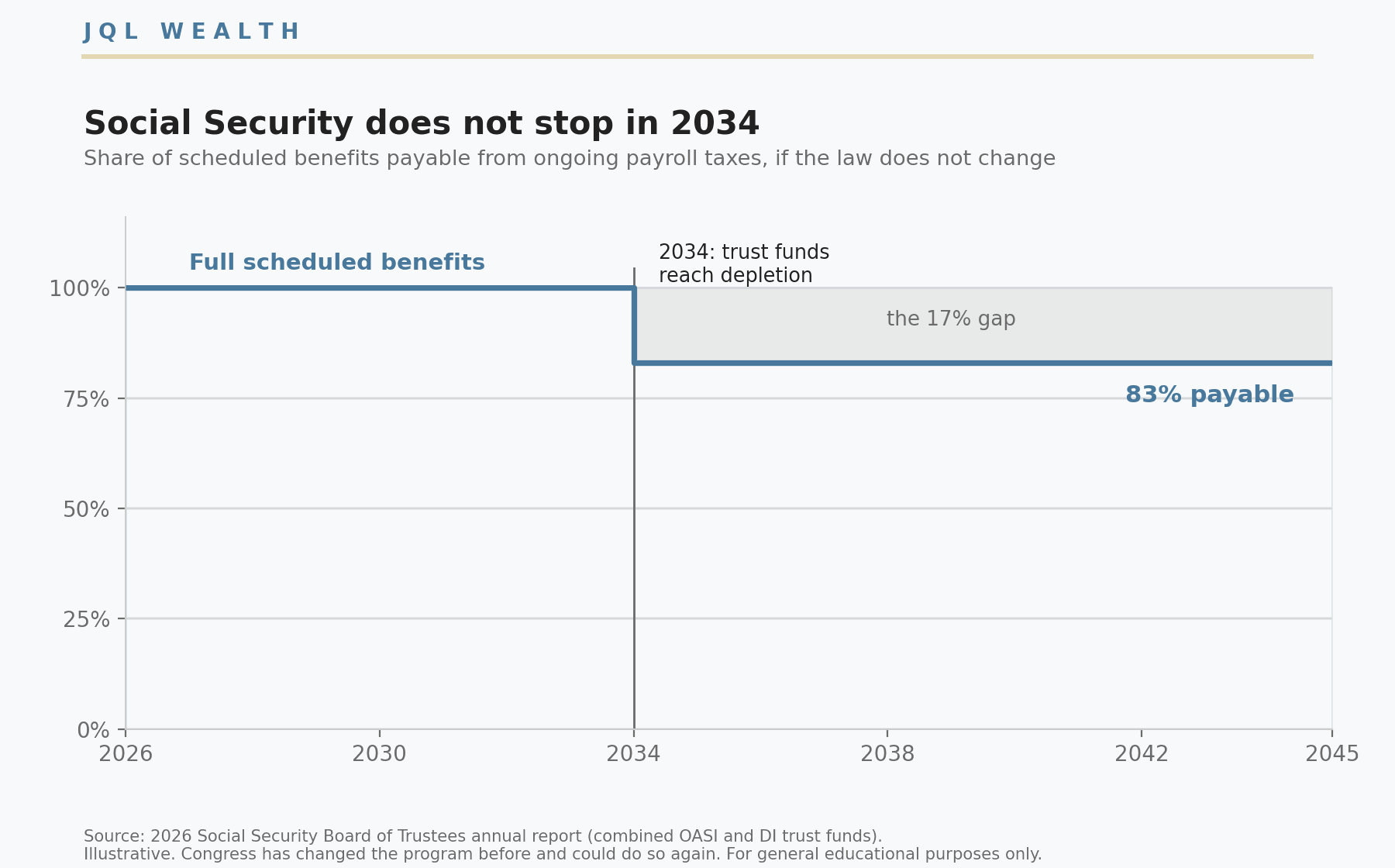
Social Security. The program is not going away, and I try not to add to the fear around it. Here are the real numbers from this year's Trustees report. The trust funds can pay full benefits until 2034, and after that, with no change in the law, about 83% of scheduled benefits are still payable out of ongoing payroll taxes. Congress has patched this before. But the realistic menu of fixes, a higher payroll tax cap, trimming for higher earners, or a later retirement age, is worth building into your plan as a range rather than a single promised number.
One item on that menu deserves its own note. Full retirement age is already 67 for anyone born in 1960 or later, and if lawmakers reach for the least painful lever, nudging that age up for younger workers is one of the easier ones to pass. If you are close to claiming, it is unlikely to touch you. If you are helping a child or a younger colleague plan, it belongs in the picture.
Cost of living. Inflation is not back to normal. Prices were up 3.4% over the year through July, against a Federal Reserve target of 2%. Take food and energy out and the number is 2.5%, which tells you exactly where the pressure is coming from. Energy rose 14.7% over the year and gasoline 24.6%. That is the war in Iran and the fight over the Strait of Hormuz showing up at your pump. The Fed made the same point when it held rates steady in July, saying inflation “remains elevated relative to the Committee’s 2 percent goal” and pointing at supply shocks in energy as part of the reason. Housing is the other half of it. There is not much on the market, so prices have not had much room to fall, and higher borrowing costs land on top of that, making a mortgage, a car loan, or a line of credit more expensive than it used to be.
Underneath all of it sits the quietest tool a government has for a debt this size. Let inflation run a little warm, and rising prices slowly shrink the real value of what is owed. It works, and it works by taking value from everyone holding cash and bonds. I am not going to tell you to overhaul a portfolio over a headline. I will say that holding some of your money in assets that can grow with prices is how you protect what your dollars will actually buy across a 30-year retirement.
A debt this size will be paid for by someone. Good planning is how you make sure as little of it as possible lands on you.
Why this matters
Forty trillion dollars is not going to take care of itself. The AI buildout is a real undertaking financed with real borrowing, and it is putting upward pressure on interest rates. Oil prices that stay higher for longer push inflation in the same direction. Steps to deal with the deficit will have to come sooner rather than later, and the longer we wait, the less pleasant the available options become.
None of that is a prediction about next year, and none of it is a reason to panic. These are slow-moving risks with a long runway, which happens to be the kind you can actually prepare for. Understanding how we got here, and the short list of ways out, is what turns a frightening headline into something you have already accounted for.
If you are five or ten years from retirement and you have wondered how the debt, rates, and Social Security fit into your own plan, I would be glad to walk through it with you, one piece at a time. Reach out and we will look at where you actually stand.
This post is for general educational purposes and is not investment, tax, or legal advice. Interest rates, inflation, tax law, and Social Security rules can and do change, and figures cited reflect data available as of August 2026. Please consult a qualified professional about your own situation. Jonathan Thomas, CFP®, is the founder of JQL Wealth LLC, a registered investment adviser.